Lower gauge, thicker steel
The scale counts backwards, which makes 26-gauge the heavier sheet next to 29-gauge.

For most roofs, 29-gauge metal roofing is the right panel, and a heavier 26-gauge pays off only in a few specific cases. Across the Southeast, 29-gauge is what houses, farm buildings and pole barns are normally roofed with, so choosing it means following the standard, not settling for less. The rest of this page explains what the gauge number means and where the extra thickness is worth the money.
Call (252) 414-5105
Get a Free Quote
The scale counts backwards, which makes 26-gauge the heavier sheet next to 29-gauge.

For most house roofs and farm roofs, 29-gauge is the right specification.

Where hail is common, 26-gauge panels dent measurably less.
Heavier steel flexes less across supports that are spaced far apart.
The panel outlasts its screws and closures by a wide margin.
We roll 29-gauge and 26-gauge panels on the same lines.

Gauge describes how thick the steel is, but the numbers behave in a way most people do not expect: the higher the number, the thinner the sheet. That makes 26-gauge thicker than 29-gauge, and 29-gauge thicker than 31-gauge. The scale comes from older manufacturing practice and is not a direct measurement of thickness, which is why it trips so many people up. What it means when you compare quotes: if one says 29-gauge and another says 26-gauge, the second is pricing heavier steel and should cost more.

Put 29-gauge on a roof whose purlins are spaced correctly and it carries the loads it will see, stands up to the weather, and with a good coating it lasts for decades. That is why it is the usual panel for house re-roofs, pole barns, equipment sheds and farm buildings: it does the job. Stepping up to heavier steel on a roof that is well supported will not add meaningful years, because the coating and the fasteners decide how long the roof lasts.

The first is a long, unsupported span. When the purlins sit far apart, thicker steel is less likely to oil-can or flex between them. The second is hail that comes back year after year, where the extra thickness really does cut down on dents. The third is a roof people walk on for upkeep, especially a low-pitched one. If your roof is none of these, we will tell you to keep the money, because it does more good spent on better screws and closures.

Our experience is that the panel rarely fails first. Screws work loose as the roof expands and contracts, washers break down under UV, and cheap foam closures squash flat, which lets wind-driven rain find its way in under the ribs. A 29-gauge roof built with good painted-head screws and proper closures will outlast a 26-gauge roof put together with bargain fasteners. If a supplier pushes a heavier gauge and never brings up fasteners, that supplier is selling you steel, not a roof that works.

A metal roof earns its keep in this weather. Correctly fastened panels resist wind uplift far better than shingles that have aged, rain runs off them fast, and the dark algae streaks that mark shingle roofs in the humid Southeast never form. A light color also sends back much of the summer heat, which you will notice in a shop or barn with no air conditioning.
Near the coast, the details count for more than gauge alone. Quality fasteners, closures at the eaves and ridge, and trim that blocks wind-driven rain decide how well a roof ages. A couple of times a year, hose the salt off, and after any named storm look over exposed fasteners.
Condensation needs planning too. On spring and fall mornings, warm damp air meets a cool panel and the underside drips. Insulation or a vapor barrier under the panels, with ventilation at the ridge and eaves, stops it, and fitting those as the roof goes on costs far less than retrofitting them.
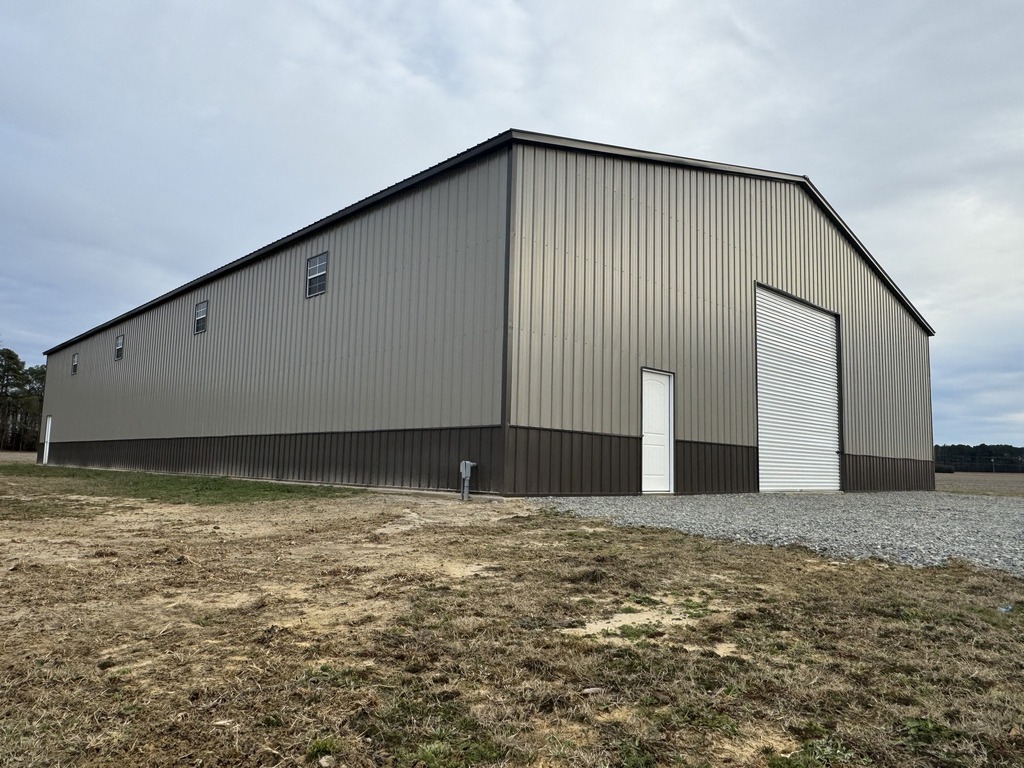
Go east of I-95 and the land turns flat. The usual soil is sandy loam over clay, and groundwater is often only a few feet below the surface. This is some of the best farmland in the country, and no state grows more sweet potatoes than North Carolina, most of them in these counties.
That same ground deserves some planning before a slab is poured. Visit the site after a downpour and mark where water collects. Raise the pad instead of excavating, pack it in layers, and give it a slope so runoff leaves by itself. Anchors have to suit sandy soil, and a low spot may be inside a mapped flood zone, so pull up your county’s flood map before you commit to a location. With those handled, the inside of a steel building in this part of the state stays dry for decades.
Yes. It is the common choice for house roofs, farm buildings and pole barns, and for the large majority of roofs it is the right specification. With purlins spaced properly and good fasteners holding it down, a 29-gauge roof lasts for decades. Treat it as the normal option, not a step down.
26-gauge is the thicker steel, since lower gauge numbers mean heavier sheet. It costs more, and the extra cost pays off in three cases: long spans with nothing supporting the panel between purlins, places where hail is common, and roofs that people walk on often. In any other case, 29-gauge is the sensible choice.
There is no single figure to quote, because gauge is an older scale for describing thickness and not a direct measurement, and the exact thickness shifts a little with the type of steel and its coating. What helps more is the comparison. 26-gauge is noticeably thicker than 29-gauge, and 29-gauge is thicker than the 31-gauge panels some big-box retailers sell.
For most pole barns, 29-gauge is the standard choice and a suitable one. If the purlins are spaced far apart, 26-gauge is worth considering, since it flexes less between them. In both cases, put real money into painted-head screws and foam closures, because those are the parts that let pole barn roofs down.
Not by a lot, as long as the roof is properly supported. How long it lasts depends mostly on the quality of the coating and the fasteners, not on the thickness of the panel. Where heavier steel does help is with hail dents and with spanning wide gaps between purlins.
Give us the dimensions, the county and what the building will hold, and we will send you a number. It reflects current steel pricing, it carries no obligation, and if a different size would suit you better we will say so.