Cut to your run
Panels are formed to the length you give us, with no fixed stock sizes.

Equipment under a barn roof that has started to leak, a shop that needs new walls, a fence line to cover: one material suits all three, corrugated metal roofing. We roll-form the panels on our own lines and cut every sheet to the exact length of your run, so no fixed stock size limits the job.
Installed, a panel has a net coverage of 36 inches. 29-gauge is the standard, 26-gauge is there for heavier-duty work, and the full range of colors is available. Order a single sheet or enough for a whole building.
Call (252) 414-5105
Get a Free Quote
Panels are formed to the length you give us, with no fixed stock sizes.
Net coverage of one installed, lapped panel.

Standard and heavier-duty steel come off one line.
Roofing, siding and fencing use the same sheet; only the detailing changes.

Screws are matched to the panel in each color we offer.
Patch part of a barn roof, or clad a whole building.

Most people say corrugated for any ribbed steel panel. Strictly, the classic corrugated profile is the wavy one, while most panels now sold for farm buildings and houses have trapezoidal ribs, which handle water better and reach farther between purlins. If you ask us for corrugated, we check which shape you mean, since a wrong order tends to show up only once the sheets are on the roof.

A single sheet does several jobs, each detailed its own way. On a roof, the ribs point down the slope and closures go in at the ridge and the eave. On a wall the sheets usually run vertically, with J-channel around the openings. Weather detailing hardly matters on a fence or an interior feature wall, but the edges do: cut steel is sharp, so ask for hemmed or trimmed edges wherever people might touch it.

On properly spaced purlins, 29-gauge is the standard and the right choice for most jobs. Where the framing is spaced wide, 26-gauge is the better pick because it resists sagging and oil-canning between supports. A fence or an interior wall spans nothing, so 29-gauge is plenty there and the heavier steel would be money wasted.

Why steel on a roof at all? Mostly for the weather. Panels that are fastened properly hold on in wind that lifts aged shingles, they send a downpour off quickly, and they never grow the black algae streaks that humid Southeast summers put on shingle roofs. Choose a light color and the roof also turns back a good share of summer heat, which you feel in a shop or barn that has no air conditioning.
Near the coast, small parts decide how a roof ages. Fastener quality, closures at the eaves and ridge, and trim that blocks wind-driven rain all count for more than gauge alone. Rinse off the salt twice a year or so, and after any named storm look over the fasteners that are exposed.
Condensation needs planning too. On cool spring and fall mornings, warm wet air meets the panel and the underside drips. A vapor barrier or insulation beneath the panels, with vents at ridge and eaves, cures it, and adding that while the roof goes on costs far less than retrofitting it.
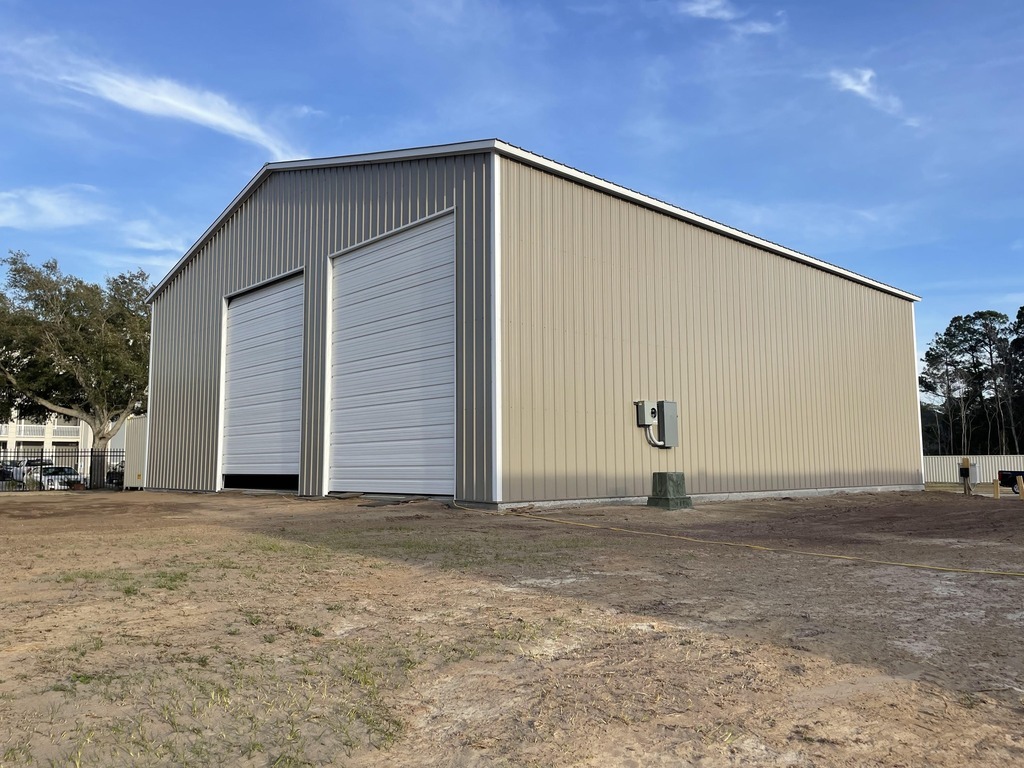
Do the paperwork before the shopping. Phone the county and ask what certification the inspector will expect for your building and what design wind speed applies at your address; the figure climbs between I-95 and the coast. Check the flood map for that address as well, because flood zones run along every river and sound in this part of the state.
Those are the questions the storms taught people to ask. Dorian in 2019 and Florence in 2018 are the freshest memories, and before them came Matthew in 2016, Irene in 2011, Isabel in 2003 and Floyd in 1999. Wind did the damage in a few of them, but water did it in most. What stuck is that anchoring and the ground under a building decide how it fares.
For that reason we ask about your site before color comes up. If the roofing is for a new building, tell us where it will stand, and we will quote drawings, anchors and framing to suit that spot.
A sheet covers a net 36 inches once it is installed and lapped. Length is up to you: we roll-form to order, so a panel can run as long as your roof does.
Yes. Ribbed steel panels are standard on agricultural buildings and pole barns, and on a large share of house re-roofs across the Southeast. How a roof performs depends on purlin spacing, closures and fastener quality far more than on the rib profile.
Yes, one panel covers all three. Only the detailing differs: a roof needs closures at the ridge and the eave, a wall needs J-channel at its openings, and a fence or interior wall may call for hemmed edges where people could brush against the steel.
There is no fixed price list; we price from the current cost of steel coil. Send us dimensions and we will quote the panels along with the trim, closures and fasteners the job needs, or phone (252) 414-5105.
Tell us the size of the job, the county and what will sit under the roof. We price from the cost of steel right now, you take on no obligation, and if a size other than the one you named looks like the better fit, we will tell you.