Matching the anchors
The anchor has to suit what is underneath, whether that is concrete, asphalt or plain ground. Too few anchors is the most common reason a building fails in wind.

How weather-resistant are metal buildings? Much of the answer can be checked before you spend anything. A seller should put the rated wind speed, the snow load and the anchor schedule in writing, tell you whether your county wants engineered drawings, and say where the panels are made; ours are formed at our plant in Farmville, NC.
The rest depends on location, because weather on the Outer Banks and weather in the Blue Ridge have little in common, yet one kind of building has to cope with both. On the coast the threats are salt in the air and winds of hurricane strength. Across the Piedmont, ice storms are one worry and clay that swells under a foundation is another. In the mountains, snow can sit on a roof for weeks. Steel stands up to all of this if the structure has been engineered and anchored to suit its site, and it performs badly if not. This guide sets out what determines how a metal building weathers, and what to check before buying.
The short answer
A metal building that has been engineered for its site and properly anchored stands up to weather very well. The galvanized steel frame will not rot, warp or become food for termites, and the painted panels throw off rain, snow and debris carried by wind. Four factors set the level of protection: the gauge of its framing, how the building is fastened down, whether the wind and snow design is certified, and how well the finish suits salty or humid air.
Call (252) 414-5105
Get a Free Quote
The anchor has to suit what is underneath, whether that is concrete, asphalt or plain ground. Too few anchors is the most common reason a building fails in wind.

Your county may require engineered drawings. Ask, and ask also what wind load and snow load the building is rated to carry.
Standard framing is 14-gauge. Sites with strong wind or heavy snow can step up to 12-gauge for extra strength.

Wash salt spray from the panels, cut back plants growing near them, and keep treated lumber and copper away from the steel.
When wind forces a door open, the whole building is pressurized. Ask about wind-rated doors if you build in a coastal county.
Gutters, or grading around the building, should send roof runoff away instead of letting it collect at the foundation.
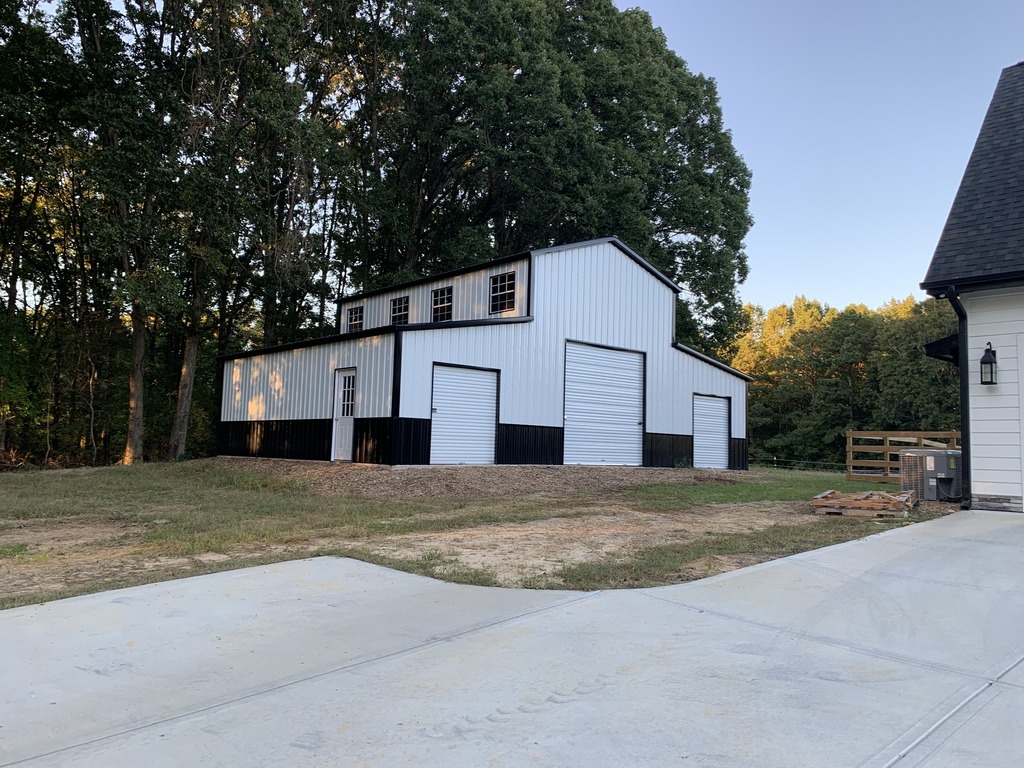
How a building fares in wind depends on three things working together: the frame, the way it is fastened down and the joints between members. The outer panels alone do not decide the outcome. For a county with high design winds, the engineer uses heavier members, or members set closer together, adds bracing, and lays out anchors to match the foundation, be it a slab, asphalt or bare earth. The wind speed the structure is rated for is written on its certified engineered drawings. Coastal parts of North Carolina and South Carolina generally demand those drawings, though your own county may or may not, and the time to find out is before you buy.
A frame crushed flat is not the usual storm damage. More often a building that was never anchored, or only lightly, has lifted, or a roll-up door has blown in and filled the space inside with pressure. A wind-rated door and a sound anchoring plan protect a building as much as the thickness of its steel does. Open carports call for extra attention, since wind pushes up under their roofs.

Bare steel rusts once moisture and oxygen reach it. That is why, near the coast, a building’s resistance depends mainly on how well its surface stays covered. The frame is galvanized: a layer of zinc sits on the steel and gives itself up to corrosion first, which spares the steel underneath. The panels carry paint over a galvanized or comparable base, and the paint warranty normally spells out how close to salt water the coverage remains valid. Trouble tends to begin at points where the coating is broken: the cut edges of panels, scratches picked up during installation, and screw heads.
Several habits add years. Wash salt spray off with fresh water. Stop plants from keeping dampness pressed against the base. Keep the steel from touching copper or treated lumber. The inside of the building needs attention too, because humidity condenses on cold metal; putting a vapor barrier beneath the slab and ventilating or insulating the roof reduces the dripping that corrodes stored equipment and fasteners from the inside out.

How much snow a roof can take is something engineers choose, not something steel brings with it. Two buildings with the same span may have different framing, sized and spaced for light snowfall at the coast in one case, and for the heavier loads of the North Carolina mountains and Southwest Virginia in the other. The slope of the roof plays a part. Snow slides off a steep roof fairly quickly; on a low-pitched one it stays, and its weight grows. Drifts that pile against a taller building next door, or against a parapet, add load at a single spot, and a calculation that spreads weight evenly would not catch it.
In counties that require certification, the engineered drawings state the ground snow load that the structure is rated to carry. In counties that do not, you should still ask what load the building was designed for. Ice storms in the Piedmont raise a related concern, because ice is much heavier than powder of equal depth. Finally, a clear span, with no posts in the middle, gives an open floor but rests all the weight on the walls and framing around the edge, so framing gauge and spacing carry real importance.

Big hailstones can leave dents in 29-gauge panels. Those dents are cosmetic and rarely cause leaks, since the panel is still whole, though it is wise to ask your insurer whether it treats cosmetic denting differently from damage that affects function, because policies differ. In heavy rain the ribbed profile of the panel does the work, guiding water down its channels. The weak spots are the places where water can find a way in: laps at the ends of panels, ridge caps, and the openings made for vents and pipes. Sealant and the right placement of screws count there. A big roof also collects a lot of water. Gutters, or grading that leads it away, keep it from the foundation, and that matters most on Piedmont clay, which swells when wet.
Heat is the last of the three. An uninsulated roof gives off heat into the room below. Ventilation, a radiant barrier or spray foam will keep a shop usable, and will also soften the noise of the panels as they warm up and cool down.

Our panels are roll-formed from raw coil, 29-gauge, at the plant in Farmville, NC. The frames are galvanized steel, 14-gauge unless the job calls for heavier duty, when 12-gauge is available. Counties that require engineered drawings for wind and snow loads can have certified ones from us. Before you buy, we say whether your site needs certification at all, which saves you from learning it at the permit counter. Our crews deliver and install, and that costs nothing when the site is within 100 miles of one of our lots, in Southwest VA, Upstate SC or NC, so the people who supplied your frame are the ones who anchor it.
To get a quote, tell the sales lot which county you are in and what kind of foundation you have; those two answers decide the framing, the bracing and the anchor package. Start by calling (252) 414-5105 or by designing the building yourself in our online 3D designer.

Steel buildings ride out storms when they are anchored well and kept up, and the upkeep is mostly small jobs. Before the season starts, go around the structure. Tighten or replace any slack fastener, clear leaves and pine needles from the roof and the foot of the walls, and try every door to confirm that it latches firmly. Pay special attention to roll-up doors: one left partly open is the most frequent way for wind to get inside.
With a storm on the way, clear anything that could blow loose from around the building, shut and secure every door, and move vehicles from under trees. Once it has passed, confirm the anchors are still sound, run your eye along the roofline for trim that has been pulled up, and wash away salt and debris. On the coast, that wash is worth ten minutes after any storm that sends wind in off the water.
Routine care through the year is brief. Panels get washed, mulch and plants stay clear of the base rail, scratches in the paint get touched up before rust gets a start, and the soil beside the pad keeps sloping away from the building.

The ground comes first. Drive east of I-95 and the land flattens out; under the fields, sandy loam lies on top of clay, and groundwater is often only a few feet down. Farmers prize it, and North Carolina’s sweet potato crop, the largest of any state, is grown largely in these counties. For a builder, the same ground calls for some forethought before the concrete is poured.
Go to the site once a heavy rain has passed and mark where water is standing. Then build the pad up above the surrounding ground rather than cutting down into it, compact the fill in layers, and shape a slope that lets runoff drain off by itself. Sandy soil needs anchors designed for it, and a low site may lie within a mapped flood zone, so consult the flood map held by the county before choosing the location. With that done well, the inside of a steel building here stays dry for decades.
It can, if three conditions are met: the design suits the wind speed your county uses, the anchoring follows the manufacturer’s specification, and the doors are rated for wind. When buildings fail, it is typically because they have no anchors, or too few. Get the rated wind speed and the anchor schedule in writing.
No more than a wooden building of equal height. Lightning strikes the tallest object near it, whatever the material. Steel does conduct to ground with little resistance, which is the reason bonding and grounding form part of an electrician’s work.
It can. When warm, damp air meets cold metal it condenses, and an uninsulated roof may drip on a cool morning, particularly in the humid air of the coast or the Piedmont. Dripping can be reduced, or removed, with a vapor barrier below the slab, insulation or a radiant barrier on the roof, and ventilation. Include these in the finish-out instead of adding them afterward.
No fixed number of years applies. How long a building lasts depends on the quality of its coating, how exposed the site is, how it is anchored and how it is maintained. Galvanized framing and painted panels do not fall to rot or insects and shrug off weather. To extend life, keep the coatings whole, wash off salt and handle drainage. The finish and structural warranties state the period covered.
Ice weighs more than snow lying at the same depth, which makes the rated roof load more important than what normal snowfall in your region would suggest. If the building was engineered for your county’s snow load, that is allowed for. Ask for the ground snow load it was designed to carry, above all in the mountains and the Piedmont.
Tell us roughly how big the building should be, which county it is going in and what you plan to keep inside. Our quotes follow current steel pricing, they carry no obligation, and if a different size would suit you better we will tell you.