Post-free barn interiors
Widths of 12′ to 60′ leave the floor clear, so tractors and bale equipment can move about freely.
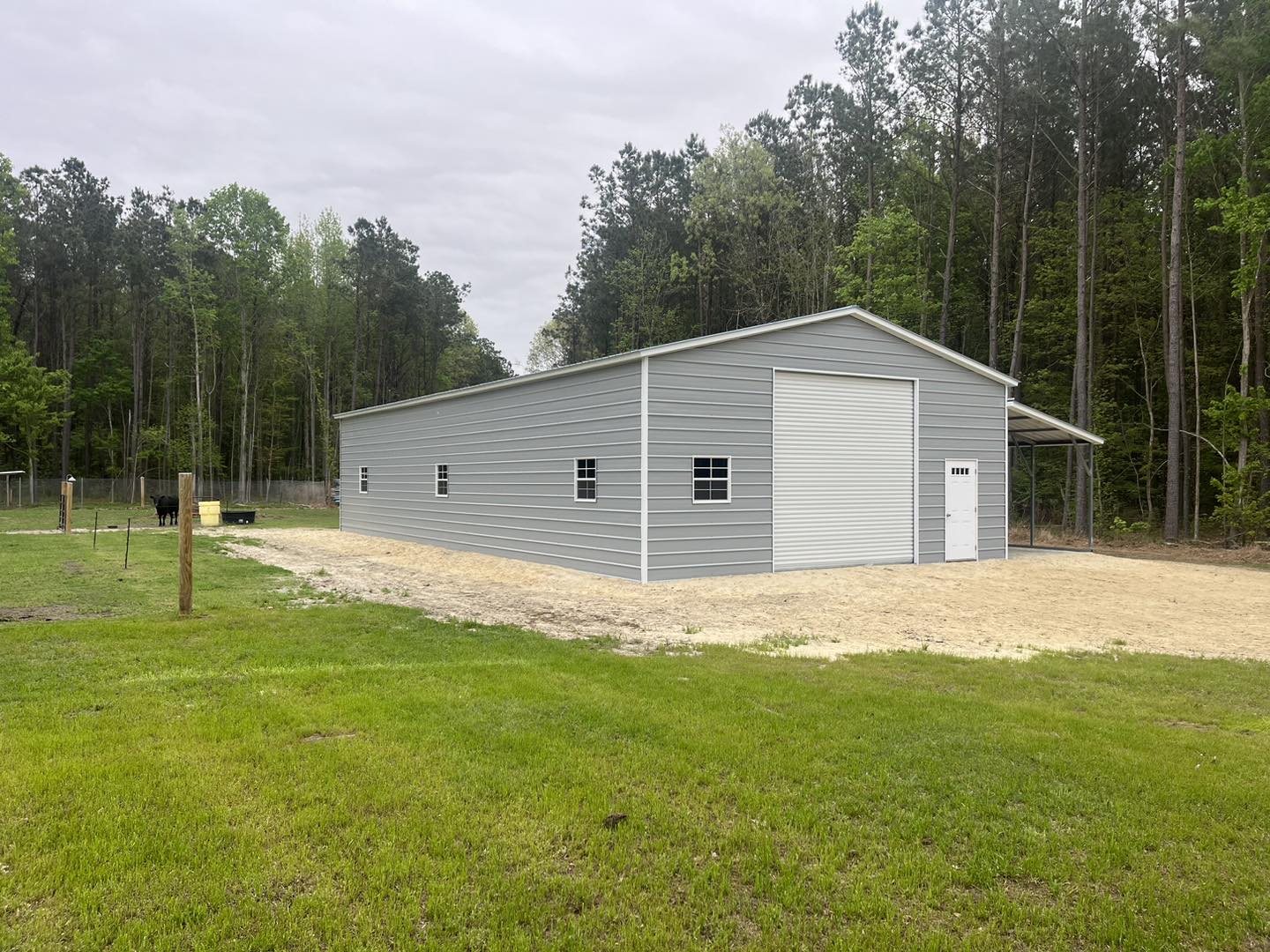
Around Williamston a new barn usually goes up where a wooden one rotted, so the real question is how to build one that will not go the same way. US 29 runs through cattle-and-hay country in northern Anderson County, and the metal buildings in Williamston, SC that we sell answer that question with steel. Our lot at 980 Beaverdam Rd sells carports, garages, shops, equipment sheds and barns made at our own plant, and our crews deliver and set them up. You can visit between 9am and 5pm Monday to Friday or between 9am and 1pm on Saturday, or call (864) 840-9033. A barn can also be sketched ahead of time in the 3D designer.
Call (864) 840-9033
Get a Free Quote
Widths of 12′ to 60′ leave the floor clear, so tractors and bale equipment can move about freely.

The frame is galvanized steel, 14-gauge as standard with 12-gauge available, so no treated post sits in the soil waiting to rot.
Our plant in Farmville, NC forms the 29-gauge roofing and siding from coil.
One set of components makes an open equipment cover, a hay barn or an enclosed barn.

A crew of ours delivers and sets up the building for any site up to 100 miles from the Williamston lot, and you hire no builder.
Each kind of building we make can be bought at 980 Beaverdam Rd, garages, shops and carports included.
All 28 lots: ecopofnc.com/locations · open Mon–Fri 9am–5pm, Sat 9am–1pm
980 Beaverdam Rd
Williamston, SC 29697
(864) 840-9033
Mon–Fri 9am–5pm, Sat 9am–1pm
9491 Augusta Rd
Pelzer, SC 29669
(864) 745-5427
Mon–Fri 9am–5pm, Sat 9am–1pm
911 Whitehall Rd
Anderson, SC 29625
(864) 745-5415
Mon–Fri 9am–5pm, Sat 9am–1pm
4314 Calhoun Memorial Hwy
Easley, SC 29640
(252) 414-5105
Mon–Fri 9am–5pm, Sat 9am–1pm

Wooden pole barns in the Upstate take punishment from three directions: termites, clay that stays wet around the posts, and a roof that wants regular attention. A steel barn from us replaces the treated posts in the ground with galvanized 14-gauge framing set on a pad, and it is sheathed in 29-gauge panels that we roll-form from coil at our Farmville, NC plant.
The clear-span design is the other gain. At widths from 12 to 60 feet there are no interior posts, so a 40-foot hay barn still leaves a tractor or a round-bale spear room to work. Legs between 9 and 12 feet tall allow bales to be stacked high or a combine header to be parked inside. The same set of components makes an open-sided equipment cover, a fully enclosed barn, or a barn with one or two lean-to sides left open. Because we deliver and install, the barn is up within days of arriving, and you have no separate contractor to fit in around haying season.

The East Carolina Outdoor Products lot is off US 29 on the north side of Anderson County, at 980 Beaverdam Rd, Williamston, SC 29697. The phone is (864) 840-9033, and the lot is open 9am to 5pm Monday through Friday and 9am to 1pm on Saturday. Pelzer lies a few minutes to the north. Belton is a few minutes south along SC 20, with Honea Path farther on beyond it, and Anderson is a short drive southwest on US 29.
Come with the dimensions of whatever you plan to store, or with a rough plan from the 3D designer. With that, the lot can settle the width, the leg height and which sides stay open or closed before you order. A quote is based on current steel pricing and usually comes back within 24 hours, and before you buy we say whether your parcel needs certified engineered drawings for wind and snow loads. The rest of our Upstate lots, among them Anderson, Pelzer and Easley, are listed at /locations/.

We print no price list, because what a barn costs hinges on how it is configured. Size and leg height lead: a 30 by 40 enclosed barn is priced differently from a 40 by 60 open equipment cover, although both are clear-span. After that come the framing, standard 14-gauge or optional 12-gauge; certified engineered drawings, if your county asks for them; and the number of roll-up doors, walk doors and open sides.
Site work sits outside the quote: grading and the pad itself, whether gravel or concrete, are separate, and any wiring or water run to the barn is a job for your own trades. To get a figure, tell the Williamston lot what you plan to store, or design the barn in the 3D designer, and a quote built on current steel pricing usually returns within 24 hours. Delivery and installation cost nothing within 100 miles of the lot, and qualifying buildings can be had rent-to-own without a credit check.

Red Piedmont clay lies under the pastures around Williamston, Pelzer and Belton, and it asks two things of anyone putting up a barn: a pad that is level and compacted, and grading that sends roof runoff away from the building. In a wet winter the clay holds water, and in a dry August it cracks, so a loose pad settles unevenly, and a slab poured with no drainage leaves water standing against the foot of the walls.
Gravel is a popular base for barns because, once compacted, it drains well and costs less than concrete. Garages, shops and any barn with a finished floor generally go on a concrete slab poured to the footprint of the building. Whichever base you choose, our crew sets anchors to suit it. Permit and engineered-drawing rules for an agricultural building in Anderson County differ with size and use, so put your parcel to the lot before you schedule the pad.
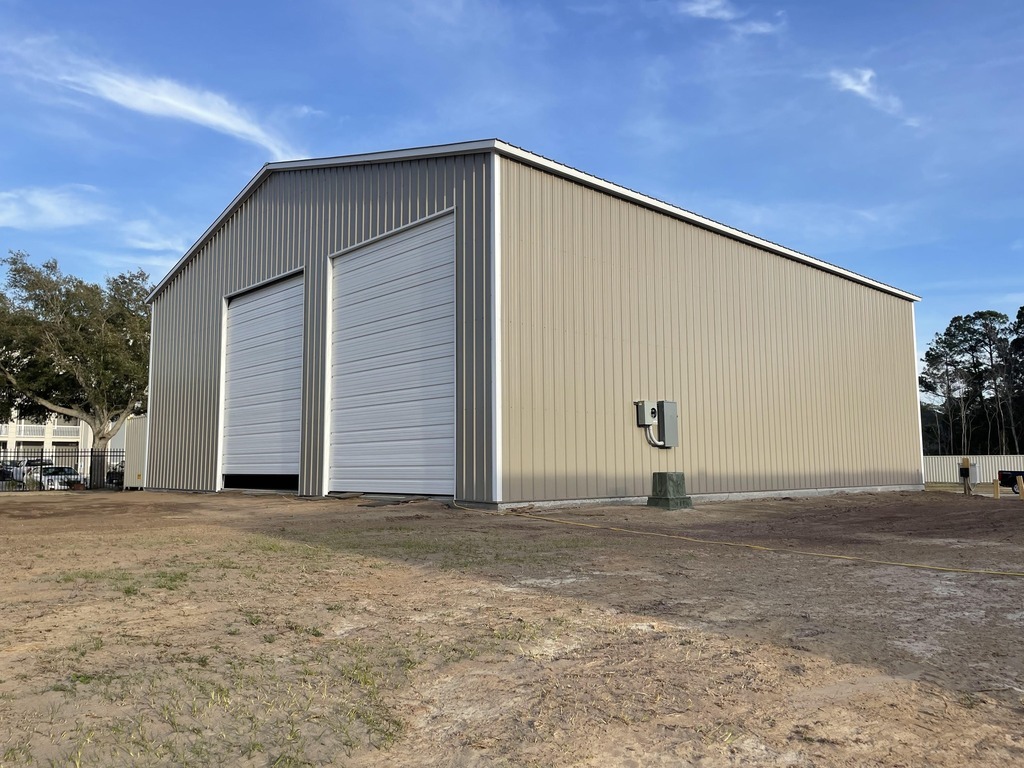
Color and width are the easy part. What makes a building worth owning in ten years is settled earlier, in three decisions. Choose the site by walking the property for ground that is high, drains well and can still be reached by truck, then measure back from the boundary lines, the septic field and the well. Ask the county inspections office which permit applies and whether drawings are needed at your size. And make an honest inventory of what the building must hold over the next five years, counting equipment you have not yet bought.
Those answers fix everything else. The inventory sets length and width, the tallest piece sets the leg height, and the debris falling on the roof sets its style; leaves, pine needles and rain run off a vertical roof best. Put the doors on the side the driveway serves. Take the inventory to the Williamston lot or submit it through the quote form, and we will turn it into a real price.

Williamston, South Carolina, is an Anderson County town built around its Mineral Spring Park, and paperwork comes before the pad. Whether Anderson County wants a permit or engineered drawings depends on the building’s size and use, and a barn may be treated differently from other structures, so ask the county first. Then ask us whether your parcel needs certified wind and snow drawings; we answer that before you buy.
The ground comes next. The Upstate is rolling country on red clay: once cut and compacted it makes a solid base, but flat lots are scarce, and the grading plan counts for more here than near the coast. Give us the fall across the footprint and the way rain runs off today. Tropical storms mostly reach this part of the state as heavy rain, though in 2024 Helene delivered wind as well. From day to day a building faces thunderstorms, hail, falling limbs and now and then an ice storm. A vertical roof drains water, leaves and ice better than a horizontal one, and a little extra leg height pays off the first time a boat on its way to Hartwell or Keowee has to fit underneath.
You will find it at 980 Beaverdam Rd, Williamston, SC 29697, just off US 29 in northern Anderson County. Opening hours are 9am to 5pm Monday through Friday and 9am to 1pm on Saturday. The lot’s own number is (864) 840-9033; our main line is (252) 414-5105.
Yes. We build the same clear-span frame with one or more sides left open when the barn is for tractors, hay and implements. Available widths are 12 to 60 feet, free of interior posts, and the legs stand 9 to 12 feet tall.
It depends on the county, the size of the building and what it is used for, and a building used for farming is sometimes treated differently, so ask the county about your parcel. If drawings are required we supply certified ones for wind and snow loads, and we tell you before you buy whether your site needs them.
No. Delivery and installation cost nothing for any site up to 100 miles from an ECOP lot, so every town in Anderson County is covered from Williamston, Belton, Honea Path, Pelzer and Piedmont among them.
Hay barns and equipment barns are commonly built on compacted gravel. When the barn has a finished floor, or the building is a garage or shop, a concrete slab poured to the footprint is the usual base. Either way the site has to be level and graded so water drains away, and our crew installs anchors that match the base.
Expect the quote within 24 hours in most cases, priced from current steel costs. After the building has been made and delivered, our crew generally has the shell standing within days. Electrical or water work you add afterward falls to your own trades, who keep their own schedule.
Give us the dimensions you have in mind, the county, and what the barn or building will hold. We base the price on current steel costs, you commit to nothing, and if a different size would do the job better we will point it out.