Steel does not rot
Galvanized steel contains no organic material, so decay and termites have nothing to work with.

You can check most of what we say about metal storage buildings for yourself. Find an older wooden shed and look at the sill plate, the framing and the roof deck, which is where wood gives out in the humid Southeast. Galvanized steel has no organic material in it, so rot and termites have nothing to work on, and you will not be replacing the building eight years from now. Our range starts with compact units and runs up to structures big enough for equipment, and every one of them is clear-span inside.
Call (252) 414-5105
Get a Free Quote
Galvanized steel contains no organic material, so decay and termites have nothing to work with.
Clear-span framing leaves the interior open, so shelving, stock and equipment can go wherever you want them.
A vapor barrier or an insulation package can be added to your order.

Roll-up doors and walk-in doors both carry commercial-grade locking hardware.

We deliver and install at no charge within 100 miles.

Rent-to-own is offered, and no credit check is required.

Wood storage buildings in the humid Southeast tend to fail in predictable places. The sill plate sits at ground level and wicks up moisture, termites find the lumber, and the roof deck goes soft. Galvanized steel has none of those weaknesses: it does not rot, insects have no use for it, and mold finds no organic material to grow on. Measured over fifteen or twenty years, steel and wood are not close in total cost.
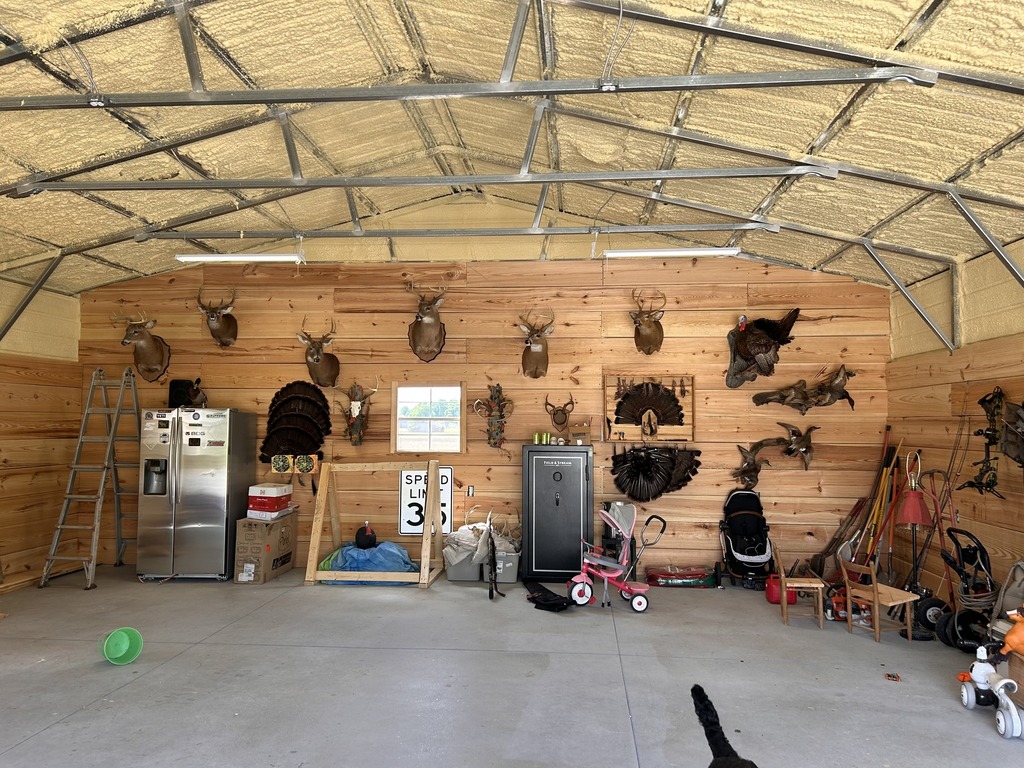
Here is the trade-off, stated plainly. When warm, humid air reaches a roof that has gone cold, uninsulated steel sweats and drips on whatever is stored below. A vapor barrier or an insulation package solves that completely, but it has to be chosen when the building is ordered. If you tell a supplier you are storing something that matters and condensation never comes up in the conversation, that supplier’s interest in your building ends with the sale.

A 12’×20′ building holds lawn equipment and the overflow from the house with room to spare. A tractor and its implements call for 20’×30′ or larger, with 12-foot eaves so nothing snags on the way in. Contractors who store materials along with a trailer usually need something around 30’×40′. Choose for what you expect to keep three years from now, not for what is parked in the driveway today. Customers who size to today’s needs end up calling us back.

The walls are rarely the weak point. What decides whether someone gets in is the roll-up door and its locking hardware, a commercial-grade lock on the walk-in door, and whether the windows show what is stored inside. Choose your hardware when you order. Upgrading it afterward is not a matter of adding a lock; the whole door has to be replaced.

In this part of the country, storage buildings seldom fail because of a storm. They fail because of damp. Cardboard sags, tools rust, and mildew takes hold in anything made of fabric. A steel building turns away rain without any trouble, but the humidity inside is a separate problem and needs a plan of its own.
Plan from the ground up. A concrete floor over a vapor barrier, or a gravel pad built up above grade with good drainage, keeps moisture from rising out of the soil. Then give the air a way to leave, with vents high on the walls or at the ridge. Raise belongings off the slab on shelves or pallets, and keep a gap between them and the wall panels so air can move behind them.
Paperwork, furniture and electronics call for more care. Insulating the roof prevents condensation, and a small dehumidifier is worth considering. Mowers, tools and seasonal gear do well enough with ventilation and a dry floor.

Make one phone call before you choose a spot. Ask your county whether a storage building of your size needs a permit, whether your land might qualify for an agricultural exemption, and whether the parcel lies in a mapped flood zone. Low ground is where the flood map matters most. If the county asks for drawings, we supply certified ones.
Then think about the soil. East of I-95 the country is level, sandy loam over clay makes up most of the soil, and groundwater can be only a few feet down. This is among the best farmland in the nation, and no other state grows as many sweet potatoes as North Carolina, most of them in these counties. The same ground asks for some forethought before concrete is poured. Walk the lot after a hard rain and note where water stands. Build the pad up instead of digging down, pack it in layers and give it a slope that sends water away. Sandy soil needs the right anchors. Do all of that and the building should still be dry inside decades from now.
In the humid Southeast, usually yes. Wood storage buildings fail when the sill plate rots, termites get in or the roof deck decays, and galvanized steel is free of those problems. What steel gives up is condensation, which a vapor barrier or an insulation package solves if you specify it when you order.
Uninsulated steel can, if warm, humid air meets a roof that has cooled overnight. A vapor barrier or an insulation package prevents it completely. If you will keep tools, equipment or stock inside, add one when you order, rather than retrofitting it later.
For lawn equipment and extra things from the house, 12’×20′ is enough. A tractor with implements needs 20’×30′ or larger and 12-foot eaves. Contractors who store materials and a trailer usually need about 30’×40′. Size it for three years from now; customers who go by what they own today end up calling us back.
It depends on the size of the building, how permanent it is and which county you are in. In many places across NC, SC, VA and GA, buildings below a certain size need no permit, and agricultural land can qualify for exemptions. Ask your county before you order. We supply certified drawings whenever they are needed.
Yes, as long as the ground is reasonably level. We anchor with rebar in soil, asphalt anchors in asphalt and wedge anchors in concrete. If the site needs work first, we would rather tell you honestly before delivery day than after.
Give us the dimensions you are considering, your county and what the building will hold. Pricing follows the cost of steel today, so the number is a current one. Asking puts you under no obligation, and should a different size make more sense for you, we will tell you.